

AI standardizes medical record data by supporting the extraction and structuring of clinical information according to EMR fields before validation and entry into records.
A consultation generates a large amount of information, but not all data immediately appears in the structure of an electronic medical record. Medical history may be collected before the visit, symptoms may be described by patients during conversations, while assessments, diagnoses, orders, and treatment plans continue to form during the physician examination. To put this information into EMR, data needs to be identified, organized, and placed into appropriate fields.
AI standardizes medical record data solves the gap between clinical information generated throughout the care journey and the data structure required in medical records. With EMR Automation MedVita, the AI system supports extracting necessary information, structuring data according to EMR fields, and supporting the entry of validated data into records. The technology handles information processing, while humans maintain control before a complete record is formed.
Clinical data does not naturally appear in EMR structure
In actual healthcare practice, information is formed according to the patient journey rather than necessarily following the order of a form. Before examination, symptoms and medical history may appear. During discussions with physicians, additional information continues to be added along with assessments, diagnoses, orders, and treatment plans.
Meanwhile, electronic medical records require data to be organized according to defined information fields. Therefore, there is a conversion step between initial clinical data and EMR data. If this step relies heavily on manual operations, staff must read, select, and re-enter information into corresponding locations.
This is also why data standardization is not simply about changing the presentation of text. The practical challenge is identifying necessary information, determining which field the data belongs to, and converting it into a structure suitable for records. As data volume increases with the number of visits, this process becomes a significant part of post-visit work.

The AI system begins by extracting necessary information
The first step in MedVita EMR Automation is clinical data extraction. The AI system supports identifying necessary information from data generated before and during consultations. This creates a foundation for further data processing instead of requiring staff to restart from the entire original information source.
Extraction capability is especially important because input data may come from different points throughout the patient journey. Medical history prepared before examination and clinical content generated during the visit can both contain necessary record information. The system needs to identify relevant information before moving it to the structuring stage.
Extraction selects data needed for records
A clinical data source may contain more content than what is needed for a specific EMR field. If all information is transferred unchanged, the data is not truly standardized. The extraction step helps the system identify necessary components for further processing.
Through this, technology helps reduce manual review and information selection tasks. However, the system does not independently determine the professional meaning of medical records. Processed data still needs to remain within an appropriate control workflow before becoming part of a complete record.
Data before and during examination can be connected
A notable point in the MedVita process is that the system does not only process data created after the consultation ends. Necessary information can be extracted from data before and during the visit. This creates continuity between stages instead of requiring each step to generate a separate data source.
When data can continue through the journey, the value of digitalization is no longer limited to storage. Information created in previous steps becomes input for later work. This is the foundation for reducing repetitive operations in completing electronic medical records.
AI standardizes data by mapping information into EMR fields
After extracting necessary information, the next step is data structuring. In MedVita EMR Automation, the AI system supports structuring data according to EMR information fields. This step directly transforms clinical data into a format more suitable for electronic record organization.
AI standardizes medical record data therefore should not simply be understood as making text consistent in writing style. The greater value is moving data from an unstructured record state into corresponding information fields. Data becomes more convenient for validation and later record completion.
Structuring creates a bridge between clinical data and EMR
Information formed during a consultation usually follows the way humans communicate. EMR, however, requires structured data for record management. These two formats serve different purposes, requiring an intermediate conversion step.
MedVita AI system supports this conversion process. Extracted information continues to be organized according to EMR fields instead of requiring staff to manually read and classify everything from the beginning. Technology therefore helps reduce the gap between data generated in clinical activities and data needed for record management.
Standardization aims for record consistency
When information is placed into defined data fields, records can be organized more consistently compared with data entered in many different ways. According to MedVita product direction, EMR Automation aims to improve data completeness and standardize medical records.
This does not mean the AI system can guarantee all data is accurate. Standardizing structure and verifying information accuracy are two different issues. Therefore, the MedVita process includes validation before data continues into EMR fields.
Validation keeps humans in control of data
Healthcare data automation requires a clear boundary between tasks supported by systems and tasks controlled by humans. In MedVita EMR Automation, data structured by the AI system does not immediately become a complete record. Information goes through validation before continuing to be supported into EMR data fields.
This step is especially important because clinical data is directly related to patient care. The system can support information extraction and structuring, but processed results still need review within an appropriate workflow. Technology therefore reduces data processing workload rather than removing human oversight.
This organization approach also reflects the principle of applying AI systems in hospitals: automating suitable tasks without equating automation with independent decision-making. Humans continue to validate information, while the system handles repetitive operations related to data organization.
Standardized data helps reduce many post-visit tasks
The value of AI standardizes medical record data becomes clear when looking at the workload after a consultation. If clinical information must be reread, selected, categorized, and manually entered into each field, record completion continues consuming healthcare staff time. As visits increase, administrative workload also rises.
With MedVita, the process of extraction, structuring, validation, and supporting data entry into EMR aims to reduce manual input. Data created throughout the consultation journey continues to be used instead of being recreated from the beginning. This also provides a foundation for saving administrative time and improving record completeness.
More importantly, the benefit is not only in data entry speed. When data is organized in a suitable structure, hospitals gain a foundation for maintaining consistent record management. Automation therefore supports humans at the operational level while also improving how data is organized.
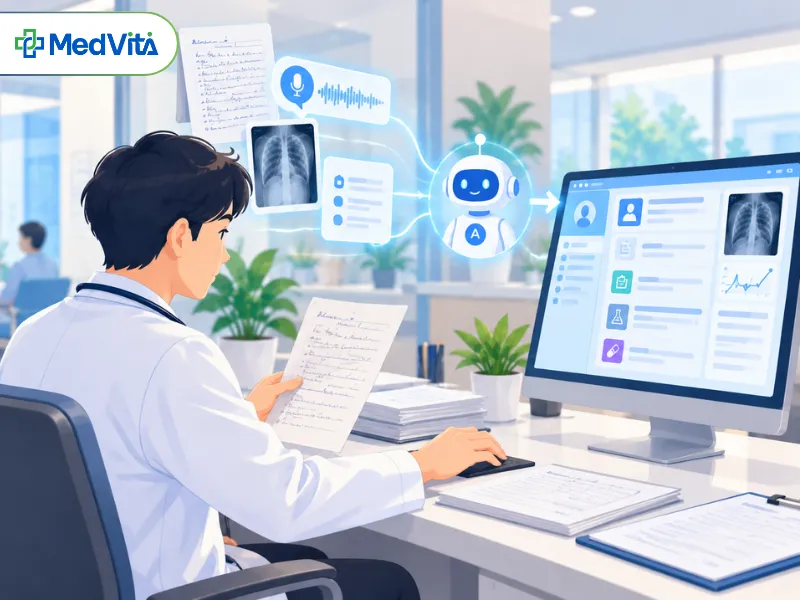
MedVita transforms clinical data into a reusable information flow
MedVita EMR Automation shows that data standardization is not a single operation. The process starts with clinical data, continues through AI extraction of necessary information, structuring according to EMR fields, validation, and support for entering data into records. Each step addresses a specific gap between initial information and a complete record.
This approach also helps data from earlier stages continue beyond its initial purpose. Medical history collected before examination and clinical content created during visits can become data sources for completing EMR. The information flow therefore has greater continuity.
MedVita does not position AI systems as replacements for healthcare staff in controlling records. Technology is used to support tasks suitable for data processing capabilities, while humans maintain validation and professional roles. This is how automation can reduce administrative burden while preserving necessary control.
Medical record standardization begins by putting data into the right structure
AI standardizes medical record data does not simply transform one document into another but supports converting clinical data into structured information suitable for EMR fields. With EMR Automation from MedVita, the AI system supports extracting necessary data from before and during consultations, structuring information, passing it through validation, and supporting entry into records, thereby aiming to reduce manual input, save administrative time, improve data completeness, and standardize medical records. When technology handles suitable tasks while humans continue controlling information, standardized data can become the foundation for a more seamless medical record management process.