
AI-assisted patient intake helps collect medical histories, support triage, and prepare information before consultations so hospitals can organize the patient journey more efficiently.
A medical consultation does not truly begin when a patient enters the doctor's office. Before that moment, the hospital needs to collect information, understand the patient's healthcare needs, and organize the patient flow toward the appropriate next step. If most tasks only begin after patients arrive at the healthcare facility, many activities will be concentrated at the same time.
AI-Assisted Patient Intake opens up a different way to organize the pre-consultation stage. Instead of only recording administrative information, the system can assist with medical history taking, collecting patient histories, triage, and preparing summaries for doctors to reference. With Smart Reception from MedVita, technology is introduced at the very beginning of the patient journey to help prepare data earlier and continue supporting subsequent stages.
Patient Intake Is More Than Completing Pre-Consultation Procedures
The intake stage is often the first point of connection between patients and the hospital's workflow. At this stage, healthcare facilities need not only to know who the patients are but also to obtain initial information to organize their subsequent journey. Symptoms, medical history, current medications, and related factors can all become essential data before doctors begin examinations.
If this information is collected only after patients arrive at the hospital, the workload can easily become concentrated at the reception desk or in consultation rooms. Staff must handle multiple patients at the same time, while doctors may need to spend part of the consultation gathering basic information from scratch.
Therefore, optimizing intake is not simply about shortening a few administrative tasks. The greater value lies in the ability to prepare data in advance and ensure that the information continues to be used throughout the patient journey. When the initial stage is better organized, subsequent stages also have better conditions for operating seamlessly.

AI Systems Move Medical History Collection to Before the Consultation
One of the direct applications of AI-Assisted Patient Intake is collecting initial information before doctors speak directly with patients. Through MedVita's Smart Intake feature, patients can use the MedVita app at home or in the hospital. The AI system conducts question-and-answer interactions to help collect the necessary data.
This approach changes when data begins to be generated. Instead of waiting until patients enter the consultation room, some information can already be prepared during the pre-consultation stage. Technology thus makes use of the time before the meeting between doctors and patients to perform appropriate tasks.
Medical History Taking and Initial Information Collection
According to MedVita product information, the AI system helps collect symptoms, medical history, current medications, and related information through question-and-answer interactions. This data provides an initial information source for the intake journey. Patients can provide information through a system-supported process rather than having all information gathering take place directly in the consultation room.
The system's ability to take medical histories does not mean that technology replaces doctors in conducting examinations. This is a data preparation step that gives doctors additional information to reference and verify when meeting patients. Assessing patients' conditions and making professional decisions remain the responsibility of qualified healthcare professionals.
Summarizing Medical Histories into Structured Information
After the information collection process, MedVita helps compile the data into a structured medical history summary. This is an important step because data is truly useful only when organized in a way that makes it convenient for the next person handling it. Information provided by patients through question-and-answer interactions needs to be transformed into content that is easier to reference.
The summary is then sent to the doctor to support the consultation. The data therefore does not stop at the intake system but continues into clinical activities. This creates an additional information link between the pre-consultation and consultation stages.
Early Triage Helps Hospitals Organize the Patient Journey More Effectively
Patient intake also involves determining where patients should go after providing their information. When triage is handled only after patients have arrived at the healthcare facility, it becomes another task that must be completed during the pre-consultation period. With a large number of patients, these intermediate steps can affect operational flow.
MedVita uses initial information to help its AI system support triage and suggest appropriate specialties. Thus, the information provided by patients is not merely stored but also becomes an input for organizing the next step. The technology helps transform intake from an information-recording point into an integral part of the care pathway.
Intake Data Is Used Directly in the Workflow
One limitation of digitization is that data may be collected without immediately creating value for subsequent activities. If information remains at the intake stage and staff still have to restart the processing at the next step, the benefits of technology will be limited. The ability to use data to support triage helps change this.
Information about patients' initial conditions becomes part of the patient-flow organization process. The system assists with data processing, while healthcare teams continue to oversee activities requiring professional expertise. This is how technology complements the workflow rather than creating another independent layer of tasks.
Patient Flow Can Be Prepared Earlier
When hospitals have more information before consultations and access to triage support, the patient journey can be prepared earlier. Tasks that would normally be concentrated at the time patients arrive at the healthcare facility can potentially be moved to an earlier stage or supported by the system.
Under the Smart Intake approach, MedVita aims to optimize patient flow and reduce waiting times. This value does not come from skipping necessary steps but from reorganizing when and how those steps are performed.
Doctors Receive More Than an Administrative Record Before the Consultation
An intake system focused solely on procedures mainly helps hospitals identify registered patients and determine where they need to go. When the intake process also includes prepared medical history data, the information delivered to doctors can provide more direct support for the consultation.
With MedVita, a medical history summary is generated from the preceding history-taking process and sent to the doctor. Doctors can use this information as a reference, verify it, and continue gathering any additional details required. Technology does not replace the conversation; it helps ensure that the conversation starts with more information available.
This also clarifies the difference between automating intake and automating clinical activities. The AI system handles tasks such as asking questions, collecting, organizing, and forwarding information. Doctors remain responsible for interacting directly with patients, verifying data, and conducting professional assessments.
AI-Assisted Intake Creates Value Across Multiple Hospital Roles
The value of AI-Assisted Patient Intake The value of AI-assisted intake is not limited to the patient experience. When some information is prepared in advance, the intake stage gains additional tools for organizing data and patient flow. Tasks that would otherwise be concentrated when patients arrive can be distributed more appropriately.
For doctors, summarized initial data provides additional information to reference during consultations. Interaction time does not necessarily have to begin entirely with collecting basic information. According to the product's objectives, Smart Intake aims to shorten consultation times and increase the time available for specialized care.
For patients, being able to provide information in advance and receive triage support creates a more proactive journey. The goal is not to eliminate interactions with healthcare staff but to reduce tasks that technology can assist with. People remain involved wherever communication, oversight, and professional expertise are required.
MedVita Turns Intake into the Starting Point of the Data Flow
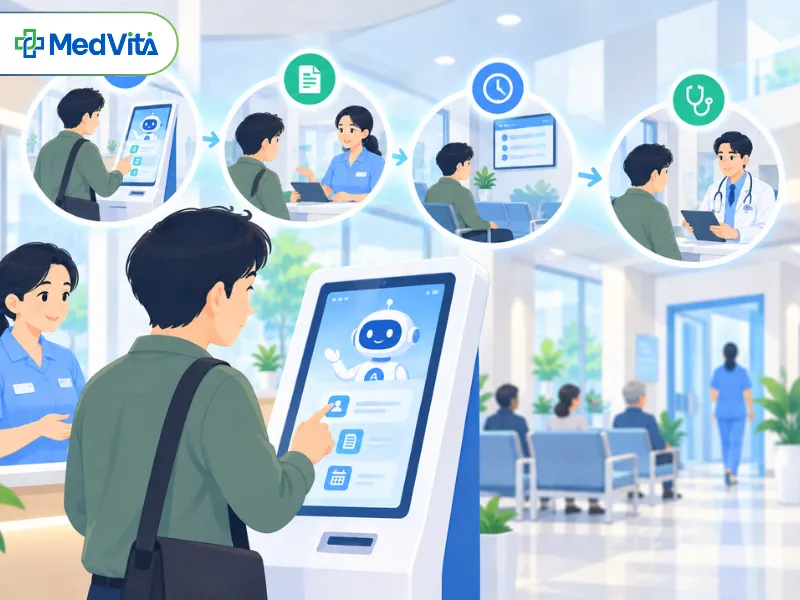
MedVita's Smart Intake means more than just a medical history-taking tool. The process begins when patients use the app, continues as the AI system helps collect medical histories and supports triage and specialty recommendations, and then produces a summary for the doctor. Data is generated at the initial stage and continues to create value for subsequent steps.
This also lays the foundation for connecting intake with other stages of the MedVita ecosystem. During consultations, clinical data collection and summarization continue to be supported; after consultations, information can be structured to help complete the EMR. Between visits, ongoing care generates additional data throughout the patient journey.
Intake is therefore no longer an isolated step outside the consultation room. It can become the starting point of a continuous information flow, with technology helping data accompany patients through each stage while doctors and healthcare teams continue to play the central role.
Smart Intake Begins with Preparing the Right Information Early
AI-Assisted Patient Intake creates value when technology does more than digitize registration tasks and actively helps prepare the pre-consultation journey. With MedVita, the AI system assists with medical history taking, medical history collection, triage, specialty recommendations, and the preparation of information summaries for doctors to reference. This approach aims to reduce waiting times, optimize patient flow, and make consultation time more effective. Technology handles appropriate information-processing tasks, while doctors and healthcare teams retain clinical oversight, turning patient intake into the starting point of a human-centered care journey.