

Fragmented medical data makes information lack continuity and increases data processing work, causing difficulties in hospital operations and patient care.
Hospitals generate data at almost every point in the patient journey. However, having a lot of data does not mean hospitals always have a continuous information flow to use.
Fragmented medical data appears when information is scattered across stages, systems, or processes without proper connection. The solution should focus on maintaining data continuity throughout the patient journey rather than digitizing isolated tasks.
Data exists in many places but may not form a unified journey
A patient can generate many groups of data during the same care journey. Initial information is collected at admission, clinical content is created during visits, and necessary data is added to electronic medical records. Home care activities create additional information.
The problem appears when these data are handled as separate parts. Previously collected information may not be prepared for later stages, forcing staff to search, compile, or re-enter data. Hospitals may have much data but limited continuous exploitation.
Fragmentation should not only be viewed as data being stored across multiple software systems. Gaps can also appear between processes, timing, and information organization. An effective digital journey must allow data to continue creating value.

Fragmented data increases information processing workload
One obvious difficulty when data is not connected is the increase in extra operations. Existing information may still need to be reviewed for later work. Repeated over many visits, data processing time can become a significant operational burden.
Fragmentation not only increases workload but also forces healthcare teams to switch between multiple information sources. Technology may only move work from paper environments to digital ones instead of reducing it.
Re-entering data creates additional administrative work
If examination data cannot be conveniently reused in EMR, staff may need extra steps to transfer information into records. This administrative work requires time and attention, especially as patient numbers increase.
A continuous data flow can reduce the need to restart at each stage. Information created before and during visits can become input for record completion when properly extracted and structured. Automation can help reduce repetitive tasks.
Searching and compiling information disrupts workflows
Data scattered across many points makes it harder to form a complete patient picture. Doctors or staff may need to gather information from different stages before use, reducing time for professional work and patient interaction.
This shows that digitizing individual steps is not enough to create a seamless process. More important is how information is transferred and organized between stages. Better connected data allows technology to reduce burdens.
Fragmentation makes it difficult for doctors to access continuous information
During care, doctors need various information to understand patient conditions. If previous history, visit data, and earlier records are scattered, doctors may spend more time building the necessary picture. The issue is not lack of data but poor availability at the right time.
Continuity becomes more important when patients have multiple visits. Each interaction adds new information while previous data remains valuable. Separate data points can make a long care journey appear as isolated visits.
Fragmented medical data therefore directly affects how information serves people. An effective system must not only store data but organize it so healthcare teams can access and use it properly.
Data gaps also appear after patients leave the hospital
Care does not end after a visit. Patients may need medication, follow-ups, tests, symptom monitoring, or lifestyle guidance. This stage continues generating information outside the hospital.
If data is only updated when patients return, the period between visits becomes an information gap. Home activities are mainly recorded later, making continuity harder to reflect.
Home monitoring helps fill gaps between visits
Care support systems can create additional information collection points when patients are at home. In Personalized Care of MedVita, the AI system supports symptom monitoring and treatment adherence tracking. These data help keep periods between visits connected.
Updating home data does not replace doctor evaluation. The system supports monitoring and recording while healthcare teams apply expertise when assessment is needed.
Data can continue supporting the next visit
When information between visits is updated, it becomes an additional reference source when patients return. Doctors have both previous visit data and home-care information, making the journey more continuous.
This differs from managing individual visits versus managing the patient journey. Each interaction can add data for future stages. This continuity is essential for reducing information fragmentation.
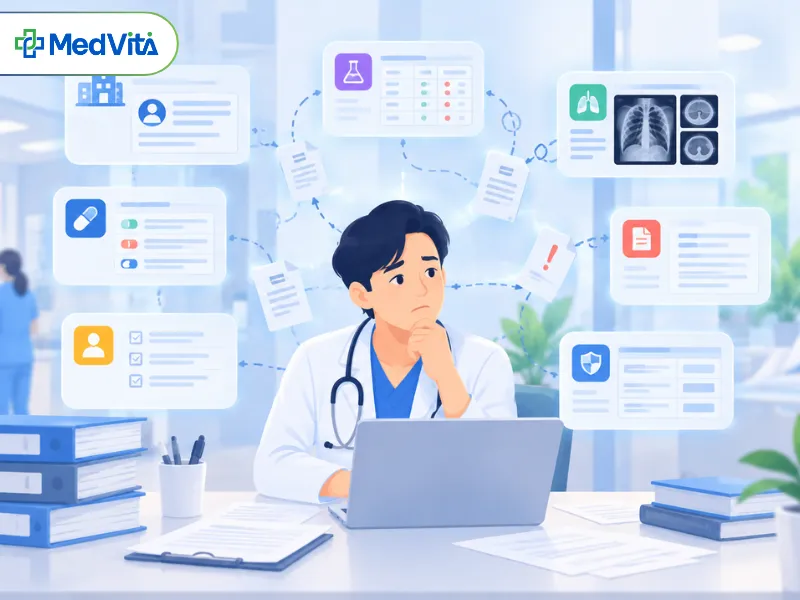
Reducing fragmentation should begin with connecting data along the patient journey
To solve fragmented medical data, hospitals do not necessarily only need another storage tool. The key issue is where data is created, how it is processed, and how it can serve future steps in the journey.
MedVita approaches data through pre-visit, during-visit, post-visit, and between-visit stages. AI supports history collection, clinical note support records conversations, and EMR automation extracts and structures information.
After patients return home, Personalized Care continues creating data from monitoring and care plans. This approach allows information to create value across stages instead of stopping after individual tasks.
MedVita aims for a more seamless data flow for hospitals
The value of MedVita is not only applying AI to different tasks. When solutions are viewed as one journey, the key is reducing the gap between where data is created and where it is reused.
This approach maintains human roles in areas requiring control and expertise. Doctors remain responsible for clinical assessment while structured EMR data is validated before entering records.
When data connects better, hospitals can reduce repetitive work, processing time, and build a more complete view of patient journeys.
Connecting data to connect the entire care journey
Fragmented medical data Hospitals struggle not because they lack information but because information can be divided across stages, creating processing work and limiting continuity. MedVita aims to narrow these gaps by supporting data from admission, examination, EMR completion, and between-visit care, with AI handling suitable information tasks while humans maintain control and expertise.