

A digital ecosystem for hospitals connects data and workflows before, during, and after consultations, helping reduce manual tasks and build a seamless care journey.
Hospital digital transformation is not just about introducing more software into individual departments. A healthcare facility may use multiple tools for registration, medical examinations and treatment, medical record management, and patient care, yet still face challenges if data and workflows across systems remain disconnected. The value of technology can be better realized when digital touchpoints are interconnected.
A digital ecosystem for hospitals aims for a more comprehensive approach in which technology is implemented throughout the patient journey. From preparing information before consultations and supporting physicians during appointments to completing medical records afterward and maintaining care between visits, each solution serves a distinct role while contributing to a continuous flow of data. This is also how MedVita builds an AI platform to support smart hospital operations, with people at the center.
Hospitals need more than standalone digital tools
Each stage of the healthcare journey creates different needs. Registration staff need initial information to guide patients, physicians need data to support examinations, medical records must be completed after consultations, and patients still need to follow their care plans when they return home. If each activity uses a separate tool without proper integration, technology may address individual tasks without creating a unified journey.
Data also risks becoming fragmented across different interaction points. Information provided by patients at an earlier stage may need to be processed again at a later stage, while healthcare teams must spend additional time searching for, consolidating, or entering data. In such cases, the number of tools increases, but the amount of work involved does not necessarily decrease accordingly.
A digital ecosystem needs to bridge the gaps between these technological touchpoints. Information generated at one stage should be able to support relevant tasks at the next stage. Technology can then do more than digitize individual tasks; it can help create a more seamless operational workflow.
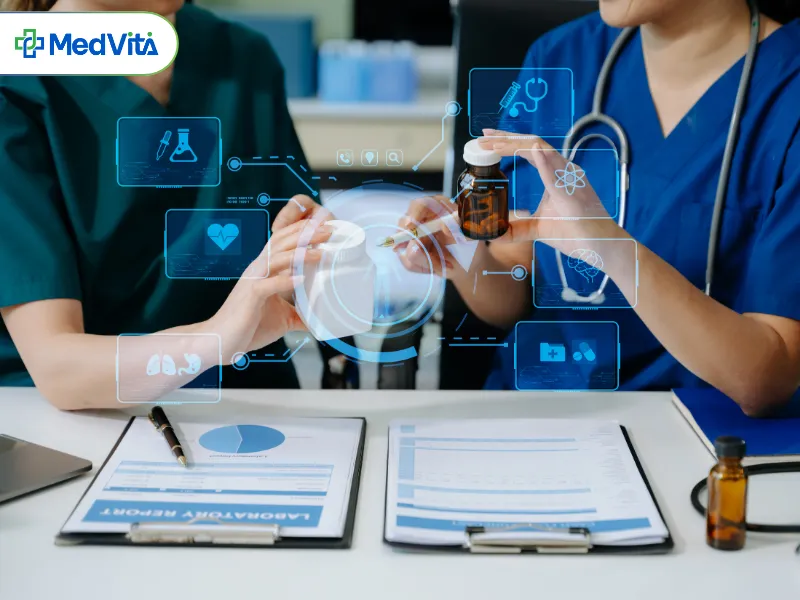
A digital ecosystem connecting the entire journey before, during, and after consultations
One A digital ecosystem for hospitals can be understood through the patient journey itself. Before meeting a physician, the primary needs are preparing and organizing information. During the consultation, technology should help physicians process data without interrupting interactions, while the subsequent stages involve completing medical records and continuing care.
MedVita addresses this journey through groups of solutions positioned at each stage. Smart Intake supports pre-consultation activities, Clinical Documentation operates during consultations, EMR Automation assists after consultations, and Personalized Care maintains connections between visits. These solutions serve different functions but all revolve around patient data and the care journey.
Before and during consultations
Before a consultation, Smart Intake helps patients provide their symptoms, medical history, current medications, and other relevant information. The AI system supports medical history taking, data collection, triage, specialty recommendations, and the creation of a medical history summary for physicians. Information can therefore be prepared in advance rather than only beginning to take shape when patients enter the examination room.
During the consultation, Clinical Documentation continues to support the flow of data by capturing physician–patient conversations, identifying clinical content, and generating structured summaries. The technology works in the background to reduce the burden of documentation. Physicians remain responsible for verifying information and conducting professional assessments.
After consultations and between visits
After a consultation, the data continues to be used through EMR Automation. The AI system helps extract necessary information, structure it according to EMR fields, and pass it through a validation step before assisting with entry into the medical record. The workflow aims to reduce manual data entry, save administrative time, improve data completeness, and standardize medical records.
When patients return home, Personalized Care continues the journey between visits. MedVita supports care plans based on medical records and physician instructions, medication reminders, follow-up appointments, tests, symptom monitoring, and adherence tracking. Data collected during this stage can provide additional information for the next consultation, creating a more continuous cycle of care.
Continuous data is the core value of a digital ecosystem
The connection between solutions is not simply that they coexist within the same hospital. More importantly, it lies in their ability to use data throughout the care journey. Information collected before a consultation can support the appointment, data gathered during the examination can contribute to the medical record, and home care activities can generate additional information for the next interaction.
This approach helps move away from treating each consultation as an isolated event. Patients follow a journey that extends across multiple interaction points, so data should reflect that continuity. When information is better organized, physicians and operational teams are better equipped to access the data they need at each moment.
Reducing repetitive operational tasks
When data can be carried forward, hospitals become less dependent on collecting or re-entering the same information at multiple stages. AI systems can support tasks such as data collection, summarization, extraction, and structuring. Manual tasks can therefore be reduced across the entire journey rather than only within a single department.
This value becomes particularly clear when looking at the process from pre-consultation through EMR completion. Data generated throughout the journey can continue to be processed instead of requiring a new round of data entry at every step. This gives staff more opportunities to focus on oversight, clinical expertise, and patient interactions.
Creating a continuous care journey
Continuous data also makes the period between consultations part of the care journey. Information about symptoms, adherence, and home care activities can continue to be updated. As a result, the next consultation can draw on additional data about what has happened since the previous interaction.
A digital ecosystem therefore connects not only departments within a hospital but also extends that connection to patients after they return home. Technology becomes a bridge that helps maintain information across different points in time. This provides a foundation for a model of care centered on patients rather than individual consultations.
AI technology helps the ecosystem process larger volumes of information
When data is generated throughout the care journey, the next challenge is how to process that information without adding to the burden on healthcare teams. AI systems can support tasks such as medical history taking, conversation recognition, summarization, extraction, and data structuring. These are areas where technology can complement human information-processing capabilities.
However, implementing AI systems in hospitals requires clear role boundaries. Tools can help prepare and organize information, but that does not make them substitutes for physicians in clinical assessments and decisions. In MedVita's EMR Automation workflow, a validation step is also maintained before data is added to the medical record.
This approach ensures that the digital ecosystem does not become an operating model entirely dependent on automation. Technology handles tasks suited to its data-processing capabilities, while people continue to oversee the process and make decisions requiring professional expertise. Efficiency comes from collaboration between these two roles rather than replacing one with the other.
A digital ecosystem creates value for both hospitals and patients
For hospitals, connecting solutions along a shared journey creates opportunities to optimize multiple operational touchpoints simultaneously. Registration can be better prepared, physicians can spend less time on documentation, EMR data can be structured with technological support, and care can continue after patients leave the healthcare facility. The benefits come not from a single tool but from connecting these support points.
For healthcare teams, the ecosystem directs technology toward information-processing and administrative tasks that can benefit from assistance. Physicians have more opportunities to focus on interactions and clinical expertise, while staff can reduce some repetitive work. People remain at the center but gain additional tools to make their work more efficient.
For patients, the journey can become more seamless, from preparation before a visit to the period of care at home. Information is prepared in advance, continues to be used during consultations, and is updated between visits. Patients can therefore experience continuous care rather than appearing in the system only at the moment they visit the hospital.
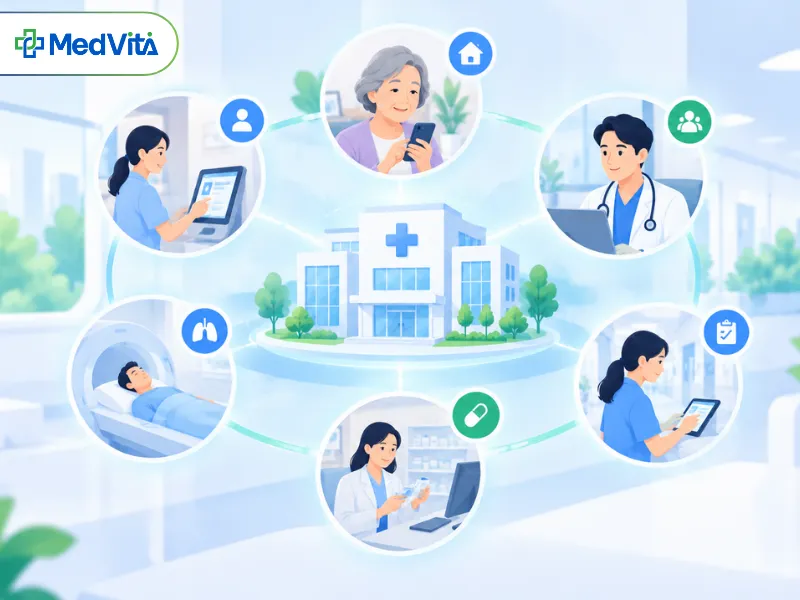
MedVita aims to build an integrated ecosystem rather than a collection of disconnected solutions
MedVita is designed as an AI platform that supports smart hospital operations by introducing technology at multiple points throughout the healthcare journey. Smart Intake, Clinical Documentation, EMR Automation, and Personalized Care address different challenges but can be viewed as parts of the same sequence before, during, and after consultations, as well as between visits.
This approach allows MedVita to go beyond automating a single task. The broader focus is on enabling data to deliver value at every stage and reducing disruptions throughout the journey. AI systems support information processing, while physicians, healthcare teams, and patients remain the central participants.
An ecosystem only becomes truly meaningful when all its components serve a shared goal. For MedVita, that goal is to help hospitals operate more seamlessly and make technology a natural part of the care journey rather than adding new layers of tasks for people.
A digital ecosystem creates value when every technological touchpoint is connected
A digital ecosystem for hospitals is not simply created by adding more and more software. Instead, it requires connecting technology, data, and people throughout the entire care journey. With MedVita, solutions ranging from Smart Intake and Clinical Documentation to EMR Automation and Personalized Care aim to create continuity before, during, and after consultations and between visits. When AI systems handle appropriate tasks such as collecting, processing, and structuring information while people retain clinical responsibility and oversight, hospitals gain a stronger foundation for building a seamless digital operating model centered on patients.